pixeloraa.com

Uncategorized

What Is SEO and How Is It Used to Grow Your Business

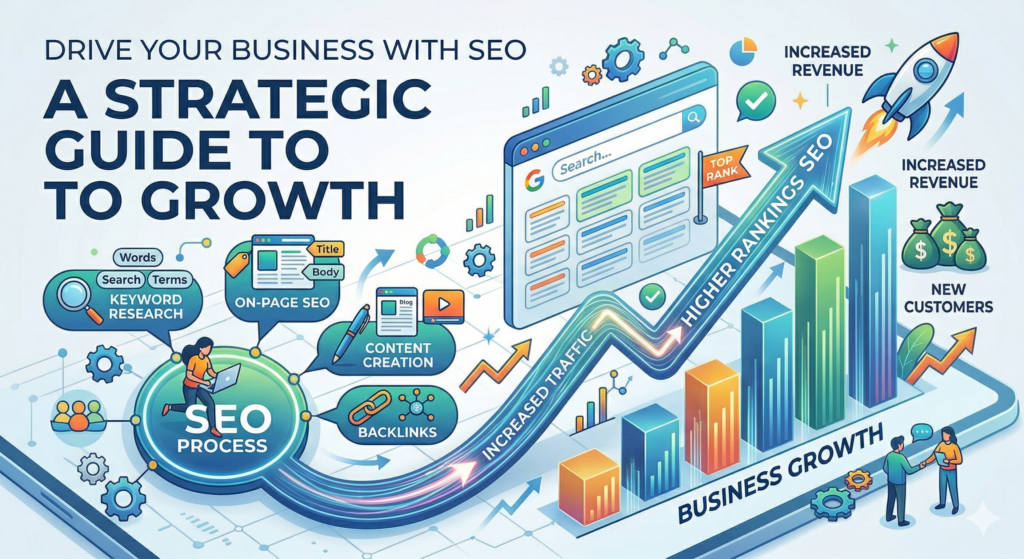
⬡ SEO What Is SEO and How Is It Used to Grow Your Business? APR 2026 15 MIN READ PIXELORAA Every second, Google processes over 99,000 search queries. Each of those searches is a potential customer looking for a product, service, or answer — and the businesses that appear at the top of those results get the clicks, leads, and revenue. SEO (Search Engine Optimization) is the science and art of making your website visible to those searching customers. It is, without question, the most powerful long-term digital marketing strategy available — and it starts with expert website design and website development. 01 What Is SEO? Search Engine Optimization (SEO) is the process of improving your website’s visibility in organic (non-paid) search engine results — primarily Google, which holds over 92% of the global search market share. When someone types a query into Google, sophisticated algorithms analyze thousands of factors to determine which pages deserve to be shown first. SEO is the practice of optimizing your website, its content, and its online reputation to align with what these algorithms favor. // What a Google SERP looks like (simplified) Rank #1 pixeloraa.com › website-design-delhi Best Website Design Company in Delhi | Pixeloraa Professional website design and website development services in Delhi. Custom, SEO-optimized websites built to convert visitors into customers. Rank #2 competitor.com › web-design Web Design Services – Competitor Agency We offer web design services for small businesses. Contact us today. Rank #3 another-site.com › design Website Design for Businesses Affordable website design and hosting packages available. The business in Position #1 captures approximately 31% of all clicks for that search. By the time you reach page 2, traffic drops to near zero. SEO determines whether your business is found — or invisible. Technical SEO audits reveal structural issues in website development that silently prevent pages from ranking on Google. 02 The Three Pillars of SEO ⚙️Technical SEOThe structural foundation — site speed, mobile-friendliness, crawlability, indexing, Core Web Vitals, and clean website development architecture. 📝On-Page SEOContent optimization — keyword usage, meta tags, headings, internal linking, image alt text, and content quality signals. 🔗Off-Page SEOAuthority building — backlinks from reputable websites, brand mentions, social signals, and local citation building. Technical SEO: The Website Development Foundation Technical SEO is where website development expertise directly determines your SEO success. Google’s crawlers must be able to access, read, and index your pages efficiently. Poor technical foundations — slow load times, broken links, duplicate content, non-mobile pages — actively harm your rankings regardless of how good your content is. Page Speed: Google’s Core Web Vitals measure LCP, FID, and CLS. Slow pages rank lower and frustrate users. Mobile-First Indexing: Google primarily indexes the mobile version of your site — every website design must be fully responsive. HTTPS Security: SSL certificates are a confirmed Google ranking signal. Clean URL Structure: Descriptive, keyword-rich URLs help both users and crawlers understand page content. XML Sitemaps: Tell search engines exactly which pages to crawl and how frequently. Schema Markup: Structured data that helps Google display rich results. Effective SEO strategy integrates website design decisions — layout, navigation, content structure — from the very first wireframe. On-Page SEO: Content That Ranks and Converts On-page SEO involves optimizing every element on your individual web pages — the content itself, its structure, and the HTML signals that tell search engines what each page is about. Central to on-page SEO is keyword research — discovering the exact phrases your target customers type into Google. Title Tags: The clickable headline in Google results — must include the primary keyword naturally within 60 characters. Meta Descriptions: 150–160 characters that compel users to click your listing. Heading Structure (H1–H6): Logical hierarchy that signals topic relevance to Google. Content Depth: Comprehensive, well-researched content that covers a topic better than competing pages. Internal Linking: Connecting related pages to distribute authority and improve crawlability. Image Optimization: Compressed files with descriptive alt text for visual search and accessibility. The best SEO strategy isn’t about tricking Google — it’s about building a website so fast, so clear, and so valuable that Google has no choice but to rank it first. On-page SEO combines keyword research, content depth, and structured headings to signal clear topic relevance to Google’s algorithms. 03 SEO and Website Design: An Inseparable Partnership One of the most misunderstood aspects of SEO is how deeply it depends on quality website design and website development. A beautiful website that isn’t built with SEO best practices is like a stunning billboard in a dark tunnel — no one sees it. The highest-performing websites marry exceptional design with technical SEO architecture — and this is precisely what Pixeloraa delivers. 04 The SEO Process: How It’s Actually Done 1 SEO Audit & Competitor Analysis Comprehensive analysis of your current website’s technical health, existing rankings, backlink profile, and deep competitor research. 2 Keyword Research & Strategy Identify the keywords your customers use — organized by search volume, competition, and commercial intent. 3 Technical SEO Fixes Resolve crawl errors, speed issues, duplicate content, broken links, and mobile usability problems — requires strong website development skills. 4 On-Page Optimization Optimize existing pages and create new keyword-targeted content — titles, headings, meta descriptions, internal links. 5 Content Creation Build a library of high-quality blog posts, landing pages, case studies, and guides that target strategic keywords. 6 Link Building Earn high-quality backlinks through digital PR, guest posting, and resource content — signaling authority to Google. 7 Monitor, Measure & Iterate Track rankings, organic traffic, CTR, and conversions monthly — continuously refining strategy to compound results. Local SEO helps Indian businesses appear in Google’s Local Pack, capturing high-intent customers searching for nearby services. 05 Local SEO: Essential for Indian Businesses For businesses serving specific cities or regions in India, Local SEO is the most impactful strategy available. It helps your business appear in Google’s Local Pack and local organic listings when nearby customers search for your services. Google Business Profile: Complete every field — category, services, photos, posts,
Uncategorized

what is the most effective email marketing strategy

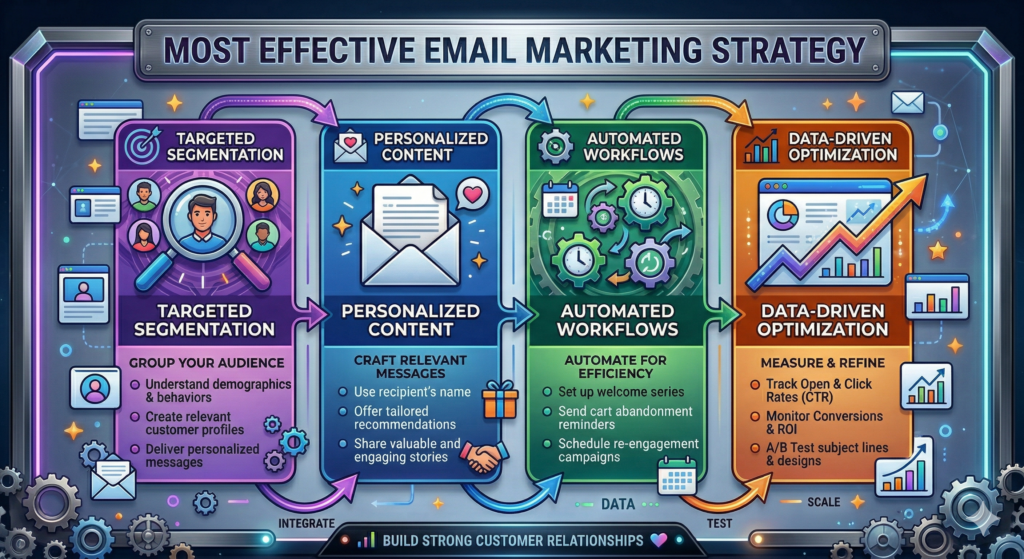
The Most Effective Email Marketing Strategy in 2026 Email Marketing The Most Effective Email Marketing Strategy for 2026 Stop guessing. Start converting. A complete, battle-tested framework for email campaigns that actually work. 📅 April 13, 2026 ⏱ 20 min read 🎯 Advanced Strategy Email marketing generates an average return of $36–$42 for every $1 spent — making it the single highest-ROI channel in digital marketing. Yet most brands are leaving 70% of that potential on the table. Here’s how to claim it. Despite the rise of social media, influencer marketing, TikTok, podcasts, and every other shiny new marketing channel, email marketing has quietly remained the most reliable, consistent, and profitable digital marketing tool available to businesses of all sizes. With over 4.5 billion email users globally and inboxes checked an average of 20 times per day, email marketing is not a legacy channel — it is the cornerstone of a modern marketing strategy. But here is the inconvenient truth: most email marketing is terrible. Generic mass blasts. Misleading subject lines. Emails that look identical on mobile and desktop (and not in a good way). No segmentation. No personalization. No strategy. The companies complaining that “email marketing doesn’t work” are the same ones sending the same promotional newsletter to their entire list every Tuesday at 10 AM without a second thought. Effective email marketing in 2026 is a science and an art form. It requires deep audience understanding, rigorous testing, intelligent automation, compelling copywriting, and a relentless focus on delivering genuine value to every subscriber, every time. This guide will show you exactly how to build an email marketing strategy that converts. $42Average ROI per $1 spent on email marketing 4.5BActive email users worldwide in 2026 347BEmails sent and received daily A great email marketing strategy begins with understanding your audience deeply before writing a single word. The Foundation: Building a High-Quality Email List The most sophisticated email marketing strategy in the world will fail if it is built on a weak or poorly acquired email list. Your list is your most valuable owned marketing asset — and how you build it will determine the quality of every campaign you run. Organic List Building: The Only Way That Lasts Never purchase email lists. Never scrape emails. Never add people to your list without their explicit consent. Beyond the obvious ethical and legal concerns (hello, GDPR, CAN-SPAM, and CASL), purchased lists are filled with invalid addresses, spam traps, and completely uninterested people. They will destroy your sender reputation, tank your deliverability, and ensure your emails end up in spam folders rather than inboxes. Instead, build your list organically through high-value lead magnets — free resources so compelling that your ideal customer willingly exchanges their email address to receive them. The best lead magnets are specific, immediately actionable, and directly relevant to your core product or service. Examples include comprehensive guides, templates, toolkits, mini-courses, checklists, case studies, webinars, quizzes, and free tools. Place opt-in forms strategically: homepage hero, blog sidebar, post-content, exit-intent popups, and dedicated landing pages. Use a double opt-in process — subscribers confirm via email — to ensure list quality and GDPR compliance. Test different lead magnets to discover what resonates most powerfully with your specific audience. Integrate your opt-in forms with your email marketing platform for seamless, automated subscriber onboarding. Implement a lead scoring system to identify your most engaged and sales-ready subscribers. • • • The Strategic Framework: The 7 Pillars of Email Marketing Excellence The most effective email marketing strategy is built on seven interconnected pillars. Master all seven and you will have a system that consistently generates leads, nurtures prospects, converts customers, and maximizes lifetime value — largely on autopilot. 1 Deep Audience Segmentation Segmentation is the practice of dividing your email list into distinct groups based on shared characteristics, behaviors, or interests — and then tailoring your messaging to speak directly to each segment. Segmented campaigns have been shown to generate 760% more revenue than non-segmented campaigns. Segment by demographics, purchase history, engagement level, stage in the customer journey, geographic location, interests declared through lead magnet choice, and website behavior tracked via email pixel data. 2 Behavioral Automation & Triggered Sequences Automated emails triggered by specific subscriber behaviors outperform broadcast emails dramatically. Welcome sequences sent immediately when someone subscribes achieve open rates of 50–60%. Abandoned cart emails sent within 1 hour of cart abandonment recover an average of 7–15% of lost sales. Browse abandonment emails, post-purchase follow-up sequences, re-engagement campaigns, and anniversary emails all leverage behavioral triggers to deliver the most relevant message at precisely the right moment. 3 Subject Line Mastery Your subject line is the single most important element of your email — because if it fails to inspire an open, nothing else matters. High-performing subject lines share several characteristics: they create curiosity without resorting to clickbait, they are specific rather than vague, they often use numbers or personal data (personalized subject lines increase open rates by 26%), they create a sense of urgency or exclusivity, and they are short enough to display fully on mobile screens (40–50 characters maximum). Always A/B test your subject lines — test one variable at a time across a meaningful sample size. 4 Email Copywriting That Converts The best email copy reads like a message from a trusted friend who happens to have exactly what you need. Write in the first person. Use the subscriber’s name. Be conversational but confident. Open with your strongest line — the inbox preview text must compel the reader to continue. Lead with value before making any ask. Use specific, vivid details rather than vague generalities. Have a single, clear call-to-action. Test long-form vs. short-form emails — both work depending on the audience and objective. 5 Mobile-First Email Design Over 60% of emails are opened on mobile devices. If your emails are not optimized for mobile, you are effectively ignoring the majority of your audience. Mobile-first email design means single-column layouts, minimum 14px body text, large tap-friendly CTA buttons (at least 44×44px),

Uncategorized

How can ai improve digital marketing for local businesses in 2026

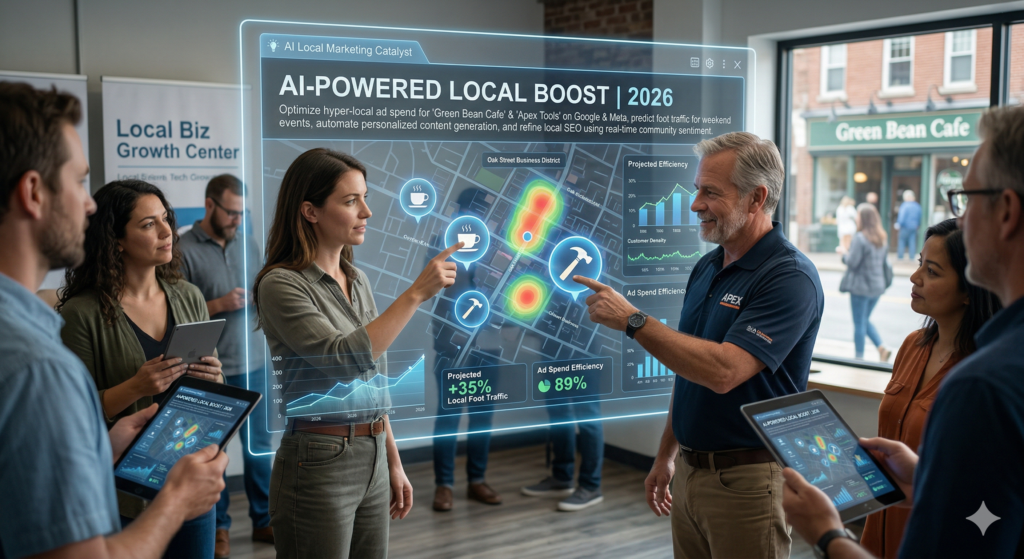
◆ AI × Marketing How AI Can Improve Digital Marketing for Local Businesses in 2026 APR·2026 16·MIN·READ PIXELORAA Artificial Intelligence has crossed the threshold from enterprise luxury to everyday business tool. In 2026, local businesses — the neighbourhood restaurants, CA firms, boutique stores, and independent clinics — now have access to AI-powered marketing capabilities that would have cost lakhs of rupees just three years ago. The question is no longer “should local businesses use AI?” but “how fast can they deploy it?” And at the foundation of every AI-powered digital marketing strategy is a robust, professionally built website design and website development infrastructure. 78%Local businesses using AI tools in 2026 4.2×Avg. ROI improvement with AI marketing 60%Reduction in content creation time 35%Avg. ad spend savings with AI targeting AI-powered tools analyze customer behavior patterns, predict purchase intent, and automate marketing responses in real time for local businesses. Why 2026 Is the Tipping Point for AI-Powered Local Marketing Several converging factors make 2026 the pivotal year for AI adoption among local Indian businesses: Affordability: AI tools like ChatGPT, Google Gemini, Midjourney, and marketing-specific platforms are now priced for SMEs — many with free or low-cost tiers. Accessibility: No coding or data science skills required. Modern AI marketing tools have intuitive interfaces usable by any business owner. Integration: AI features are now built into Google Ads, Meta Ads Manager, Mailchimp, Canva, and WordPress plugins. Competitive Pressure: Businesses that adopt AI early gain significant advantages in search visibility, ad efficiency, and customer experience. Google’s AI Overviews: Google’s AI-generated search summaries are changing how people find local businesses — making AI-optimized content a new SEO imperative. AI-Enhanced Website Design and Development Your website is the hub of all digital marketing activity — and AI is transforming what a website can do. In 2026, AI is deeply embedded in modern website design and website development, enabling capabilities that weren’t possible just two years ago. AI-Powered Personalization Advanced WordPress plugins and website development frameworks now enable dynamic content personalization — your website shows different content to different visitors based on their location, past behavior, referral source, and device type. A local dental clinic in South Delhi could show “Teeth Whitening Special” banners to first-time visitors from Instagram while showing returning visitors a “Book Your Next Appointment” reminder. AI chatbots integrated into business websites handle lead capture, appointment booking, and customer queries 24 hours a day, 7 days a week. Intelligent Chatbots and Conversational AI AI-powered chatbots have evolved far beyond scripted frustrations. In 2026, conversational AI on your website handles natural language queries, recommends products or services, captures lead information, schedules appointments, and answers FAQs — 24/7. For local businesses in India, this means never missing a lead at 11 PM, and providing instant responses that reduce friction between interest and booking. AI-Generated Website Content at Scale AI writing tools integrated into website development workflows generate first-draft service pages, location-specific landing pages for every neighborhood you serve, FAQ sections, and product descriptions at scale. Pixeloraa uses AI-assisted content workflows to help local businesses populate their websites with fresh, keyword-optimized content faster than ever before. AI-Powered SEO for Local Businesses Search engine optimization has been fundamentally transformed by AI — both in terms of how Google ranks content and in terms of the tools available to optimize it. AI SEO tools reverse-engineer top-ranking pages to give local businesses a precise content strategy for outranking competitors on Google. AI Keyword Research and Content Strategy AI-powered SEO tools like Semrush’s AI features, Ahrefs, Surfer SEO, and NeuronWriter analyze thousands of top-ranking pages for any keyword and reverse-engineer exactly what your content needs to include — topics, subtopics, word count, semantic terms, and internal links — to compete effectively. For a local business targeting “best bakery in Lajpat Nagar,” AI instantly maps the exact content strategy needed to outrank current top results. Automated Local SEO Management AI platforms now automatically monitor your Google Business Profile, suggest improvements, respond to reviews (with human approval), update business hours across all directories simultaneously, and identify local citation inconsistencies — all tasks that previously consumed hours of manual work every week. Local businesses that combine professional website development with AI-powered marketing tools aren’t just keeping up with competition — they’re operating at a level previously reserved for companies with full marketing departments. AI-Optimized Paid Advertising 🎯Google Performance MaxAI-Driven Multi-Channel CampaignsGoogle’s AI automatically distributes your ads across Search, Display, YouTube, Gmail, and Maps — optimizing in real time for the placements that drive the best results for your specific goal. 🤖Meta Advantage+Automated Audience TargetingMeta’s AI removes the need for manual audience creation. It analyzes your creative assets and landing page to identify and expand to the highest-value audiences automatically. ✍️AI Ad CopywritingDynamic Creative OptimizationAI generates multiple headline and description variants and automatically serves the best-performing combinations to different audience segments based on real-time performance data. 📊Smart BiddingReal-Time Bid OptimizationGoogle’s Smart Bidding uses machine learning to set the optimal bid for every single auction — maximizing conversions within your budget based on hundreds of real-time signals. AI content creation tools enable local businesses to maintain a consistent, high-quality presence across all digital channels simultaneously. AI-Powered Content Marketing AI Blog Writing: Tools like Claude, ChatGPT, and Jasper generate comprehensive first drafts of blog posts in minutes — a local plumbing company can publish weekly SEO content without hiring a content writer. AI Image Generation: Tools like Midjourney and Adobe Firefly create custom, original images for blog posts, social media, and website pages — eliminating stock photo costs. AI Video Creation: Platforms like Synthesia and HeyGen enable local businesses to produce professional explainer videos with AI avatars without video production teams. Social Media Automation: AI tools like Buffer AI and Hootsuite Insights automatically generate and schedule social posts at optimal times. Email Personalization at Scale: AI-powered email platforms (Klaviyo, Mailchimp AI) personalize email content, subject lines, and send times for every individual subscriber. AI analytics predict which customers are most likely to convert and which channels drive

Uncategorized

what is word press and how it is used

// Web Development What Is WordPress and How Is It Used? The Complete 2026 Guide 📅 April 2026 ⏱ 14 min read ✍ Pixeloraa WordPress powers over 43% of all websites on the internet — from personal blogs to Fortune 500 company websites. If you’ve ever wondered what WordPress actually is, how it works, and why it’s the go-to platform for website design and website development professionals worldwide, this complete guide answers every question you have. The WordPress admin dashboard — the control center for your entire website design and content management workflow. What Is WordPress? WordPress is a free, open-source Content Management System (CMS) — a software platform that allows you to build, manage, and publish websites without needing to write code from scratch. Originally launched in 2003 as a blogging platform, WordPress has evolved into the world’s most powerful and flexible website-building ecosystem. At its core, WordPress gives you a visual interface to create pages, publish blog posts, upload media, manage menus, and customize your site’s appearance — all through a user-friendly dashboard. But beneath that simplicity lies an incredibly powerful system that professional developers use to build complex e-commerce stores, membership platforms, news portals, and custom business applications. WordPress.com vs WordPress.org — What’s the Difference? Feature WordPress.org (Self-Hosted) WordPress.com (Hosted) Cost Free software (hosting costs apply) Free to paid tiers Custom Domain ✓ Full control Paid plans only Plugin Installation ✓ 60,000+ plugins Business plan+ Theme Customization ✓ Unlimited Limited Monetization ✓ Full freedom Restricted Best For Professional websites & businesses Hobbyists & casual blogs For professional website design and website development, WordPress.org (self-hosted) is always the recommended choice. It gives you complete control over your website’s design, functionality, and data. How Does WordPress Work? WordPress runs on a server (your web hosting) and uses a combination of PHP and MySQL to dynamically generate web pages. Here’s the simplified flow: // How WordPress generates a page: 1. User visits yourdomain.com/about 2. WordPress receives the request 3. PHP queries MySQL database for “About” page content 4. Your active theme template wraps the content in HTML/CSS 5. Fully rendered HTML page is returned to the browser // Result: A fast, styled, content-rich page is displayed WordPress theme customization allows designers to create unique, brand-specific website experiences without starting from scratch. Key Components of WordPress 1. Themes — The Design Layer A WordPress theme controls the visual appearance and layout of your website. Themes define your color scheme, typography, header/footer design, page layouts, and overall aesthetic. For professional website design projects, developers use premium themes as a starting point and extensively customize them with custom CSS, PHP template files, and page builders to create completely unique designs. At Pixeloraa, our website development team builds custom WordPress themes tailored to each client’s brand identity. The WordPress plugin ecosystem extends your website’s functionality with over 60,000 free and premium add-ons for every business need. 2. Plugins — The Functionality Layer Plugins are add-ons that extend WordPress’s functionality. With over 60,000 free plugins in the WordPress repository, you can add virtually any feature imaginable to your website without custom coding. WooCommerce: Transforms WordPress into a full-featured e-commerce store. Yoast SEO / RankMath: On-page SEO optimization for every post and page. Elementor / Divi: Visual drag-and-drop page builders for custom layouts. WP Rocket / LiteSpeed Cache: Speed optimization and caching for fast load times. Wordfence / Sucuri: Security protection against malware and hackers. MonsterInsights: Google Analytics integration directly in your WordPress dashboard. 3. The Gutenberg Block Editor Since WordPress 5.0, the default content editor has been Gutenberg — a block-based editor where you build pages and posts by combining modular content blocks (text, images, video, columns, buttons, etc.). It’s intuitive, flexible, and allows non-technical users to create professional-looking content layouts without coding. How Is WordPress Used? Real-World Applications 🏢 Business Websites Service companies, agencies, consultants, and corporates use WordPress for professional company sites with custom website design and brand identity. 🛒 E-Commerce Stores WooCommerce powers millions of online stores globally — from single-product shops to catalogues with thousands of SKUs. 📰 News & Publishing Major media publishers use WordPress for its powerful content management — multiple authors, editorial workflows, and infinite scalability. 🎓 E-Learning Platforms With plugins like LearnDash and LifterLMS, WordPress powers full-featured online course platforms with enrollment, quizzes, and certificates. 📁 Portfolio Websites Designers, photographers, and creative professionals showcase their work through stunning portfolio sites built on WordPress themes. 🏥 Healthcare & Professional Services Clinics, law firms, CA offices, and other professional service providers use WordPress for appointment booking and lead generation. From e-commerce stores to professional service websites, WordPress powers every type of online business with equal elegance and power. WordPress and SEO: A Natural Partnership WordPress is arguably the most SEO-friendly CMS available. Its architecture generates clean, search-engine-crawlable HTML, and with SEO plugins like RankMath or Yoast, you get granular control over meta titles, XML sitemaps, schema markup, canonical URLs, image alt text, and breadcrumb navigation. Combined with a fast-loading theme and optimized website development, WordPress gives your business the best possible foundation for ranking on Google. WordPress isn’t just a website builder — it’s a complete digital platform that grows with your business, scales with your ambitions, and adapts to every new marketing channel. — Pixeloraa Web Development Team How to Get Started with WordPress: Step-by-Step 1 Choose a Hosting Provider Select reliable hosting (Bluehost, SiteGround, Hostinger, or Cloudways) with one-click WordPress installation. 2 Register Your Domain Name Choose a domain name that reflects your brand — short, memorable, and relevant to your business. 3 Install WordPress Most modern hosting providers offer one-click WordPress installation. The entire process takes under 5 minutes. 4 Select and Customize Your Theme Choose a professional theme that matches your brand, then customize colors, fonts, and layouts. For a truly unique website design, work with a professional developer. 5 Install Essential Plugins Add SEO (RankMath), security (Wordfence), caching (WP Rocket), contact forms, and any functionality specific to your business needs. 6 Create Core

Uncategorized

How is digital marketing important for business

Digital Marketing How Is Digital Marketing Important for Business in 2026? 📅 April 2026 ⏱ 12 min read ✍ Pixeloraa Team In today’s hyper-connected world, a business without a digital presence is like a shop without a signboard. Digital marketing has transformed from an optional strategy into an absolute business necessity — and in 2026, it is the single most powerful driver of business growth, customer acquisition, and brand authority across every industry. 5.4BInternet Users Worldwide 76%Consumers Research Online Before Buying 3.2×ROI vs Traditional Marketing A solid digital marketing strategy begins with real-time analytics, keyword research, and a high-performance website as the foundation. What Exactly Is Digital Marketing? Digital marketing is the umbrella term for all marketing activities conducted through digital channels — search engines, social media, email, websites, mobile apps, and paid online advertising. Unlike traditional marketing, digital marketing allows businesses to target specific audiences, track performance in real time, and adapt strategies instantly. At the core of every successful digital marketing strategy lies a strong website design and website development foundation. Your website is your 24/7 salesperson, your brand ambassador, and often the very first impression a potential customer has of your business. Without a professionally designed and technically sound website, digital marketing efforts fall apart before they even begin. Why Is Digital Marketing Important for Business? 1. Unmatched Reach and Global Visibility Traditional marketing is bound by geography. Digital marketing eliminates these boundaries. Through SEO, your professionally developed website can attract visitors from across the country or the world, 24 hours a day, 365 days a year. With the right website design and website development approach — fast-loading pages, mobile responsiveness, and clear navigation — your business becomes discoverable to millions of potential customers actively searching for your services. SEO-optimized website development gives your business round-the-clock visibility to customers searching for your services globally. 2. Cost-Effectiveness That Maximizes ROI Digital marketing offers unparalleled cost efficiency compared to traditional methods. A well-managed Google Ads campaign, an SEO-optimized blog post, or a targeted social media campaign can deliver measurable returns at a fraction of what a print campaign costs. Investing in professional website development upfront pays compounded dividends — every SEO article you publish, every ad you run, every email you send drives traffic back to your website, converting visitors into leads around the clock. Digital marketing levels the playing field — a well-designed website and smart SEO strategy can help a small business compete with industry giants on Google’s first page. 3. Measurable Results and Data-Driven Decisions Every click, scroll, form submission, and purchase can be tracked. Tools like Google Analytics, Search Console, and Meta Business Suite give you granular insight into what’s working and what isn’t. This enables businesses to make informed decisions: which blog posts drive the most traffic, which landing page design converts best, which ad copy resonates with your audience. Data-driven digital marketing empowers businesses to measure every click, campaign, and conversion — and optimize strategies in real time. 4. Targeted Marketing That Reaches the Right Audience Digital marketing allows hyper-precise audience targeting based on demographics, geography, interests, search intent, past behavior, and device type. Whether you’re running Facebook ads targeting homeowners in Delhi, or Google Search ads appearing only when someone types “affordable website design company,” your message reaches exactly the right person at the right moment. SEO Targeting: Appear when users actively search for your service — highest purchase intent of any channel. Social Media Ads: Reach specific demographics on Facebook, Instagram, and LinkedIn. Email Marketing: Nurture existing customers with personalized content and offers. Content Marketing: Attract organic traffic through valuable blog posts hosted on your website. Retargeting Campaigns: Re-engage visitors who browsed your website but didn’t convert. 5. Building Brand Authority and Trust A business that consistently publishes valuable content, maintains an active social presence, and has a polished, professional website design is perceived as authoritative and trustworthy. Content marketing — through blog posts, how-to guides, case studies, and video — positions your brand as an expert in your field. Businesses that publish consistent, high-quality content and maintain a professional website design are perceived as the most trustworthy in their industry. 📊 Key Digital Marketing Channels for Business Growth SEO: Long-term organic visibility on Google — the most sustainable channel. PPC Advertising: Immediate traffic through Google Ads and Bing Ads. Social Media Marketing: Brand building and community on Instagram, Facebook, LinkedIn. Content Marketing: Blog posts, videos, infographics that attract and educate your audience. Email Marketing: The highest ROI channel — ₹36 return for every ₹1 spent on average. Website Design & Development: The hub of all digital marketing — where all traffic converts. 6. The Foundation: Professional Website Design and Development Every digital marketing channel ultimately drives traffic to one destination: your website. This makes professional website design and website development the single most critical investment in your marketing infrastructure. A poorly designed website wastes every rupee you spend on digital marketing. Conversely, a fast, beautiful, conversion-optimized website multiplies the effectiveness of every other channel. At Pixeloraa, our website design and website development services ensure your website is a high-performance marketing machine. Professional website design is the launchpad for every digital marketing channel. Clean website development architecture powers faster indexing and better SEO results. 7. Long-Term Asset Building A well-written SEO blog post on your website can drive organic traffic for years. Building a library of quality content, a strong backlink profile, an engaged social media following, and an email subscriber list are long-term assets that compound in value over time — delivering returns long after the initial investment. How to Get Started with Digital Marketing Step 1 — Build Your Foundation: Invest in professional website design and website development with SEO best practices baked in from day one. Step 2 — Define Your Audience: Identify who your ideal customers are, what they search for, and where they spend time online. Step 3 — Keyword Research: Discover what search terms your audience uses and build your content strategy around them.

Uncategorized

What is the benefit of performance marketing

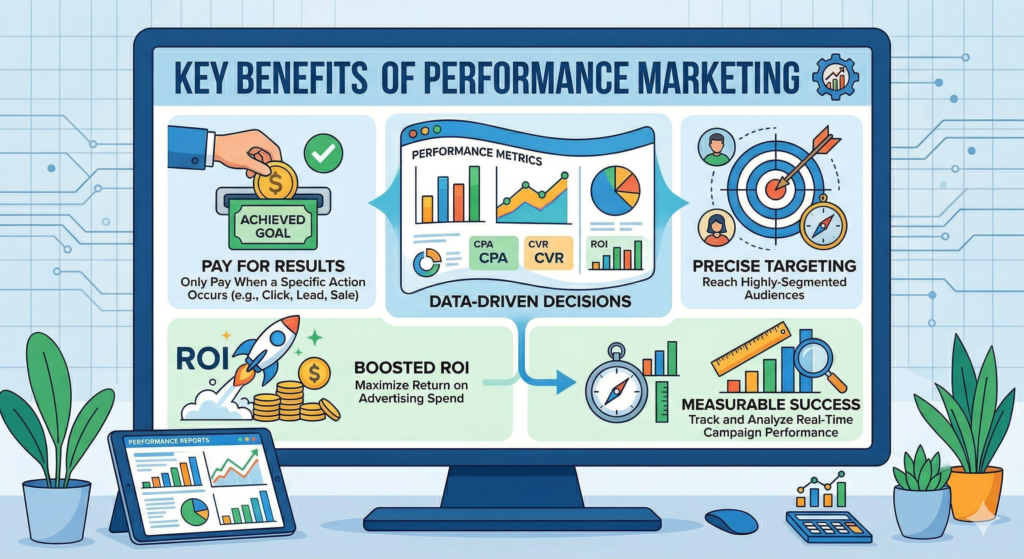
Benefits of Performance Marketing: Why Every Business Needs It in 2026 Q1 Q2 Q3 Q4 Q5 ↑ PERFORMANCE ROI GROWTH 💰 ROAS: 4.2x Return on Ad Spend 🎯 CPA: ₹840 Cost Per Acquisition 📈 CVR: 8.7% Conversion Rate ⚡ CTR: 6.2% Click Through Rate Performance Marketing THE BENEFITSOF PERFORMANCEMARKETING Why measurement-first marketing is the most powerful growth lever for businesses in 2026 april 2026 17 min read advanced guide In an era where every marketing rupee or dollar must be accountable, performance marketing has emerged as the gold standard for businesses that demand measurable results. Unlike traditional marketing that pays for exposure with no guarantee of results, performance marketing operates on a simple, powerful premise: you only pay when something happens. And in 2026, that principle is reshaping how smart businesses grow. This guide covers every major benefit of performance marketing in comprehensive detail — from its unparalleled accountability to its precision targeting, rapid scalability, and deep integration with website design and website development for maximum conversion impact. 340% Average ROI increase reported by businesses within 6 months of adopting performance marketing 72% Of enterprise marketers cite performance marketing as their highest-ROI channel in 2026 $0 Wasted on impressions that don’t convert — the core promise of performance-based models 8.7% Average conversion rate for optimized performance campaigns with matched landing pages // benefit_01MEASURABLE, TRANSPARENT ROI Every Rupee Tracked, Every Result Counted The defining benefit of performance marketing — and the reason it has become the dominant marketing philosophy for data-driven businesses — is complete, granular accountability. In traditional marketing channels like TV, radio, print, or even some forms of digital brand advertising, you pay for reach and hope for impact. Performance marketing eliminates that uncertainty entirely. With performance marketing, you know exactly how much each click costs (CPC), how much each lead costs (CPL), how much each sale costs (CPA), and what your return on ad spend (ROAS) is — down to the individual campaign, ad set, or keyword level. This level of transparency enables smarter budget allocation, faster optimization, and confident scaling of what works. For businesses investing in website design and website development, performance marketing provides the crucial feedback loop needed to understand which design elements and user flows are actually converting traffic into revenue. The data from performance campaigns directly informs website improvement decisions. PERFORMANCE MARKETING DASHBOARD ROAS 4.2x ▲ 0.6x vs last month CONVERSIONS 2,847 ▲ 23% vs last month CPA ₹840 ▼ 18% (improving) AD SPEND ₹2.4L Revenue: ₹10.08L CONVERSION TREND — 30 DAYS Midpoint Today ↑ Every data point is trackable, attributable, and actionable // dashboard.01 — a real-time performance marketing dashboard gives complete visibility into ROI // benefit_02PRECISE AUDIENCE TARGETING Reach Exactly Who You Need, When You Need Them Performance marketing platforms in 2026 offer audience targeting capabilities that would have seemed like science fiction just a decade ago. On Google Ads, you can target people actively searching for the exact products or services you offer — capturing demand at the moment of intent. On Meta Ads, you can build audiences based on demographics, interests, behaviors, life events, and purchase intentions with granular precision. Advanced targeting options include Custom Audiences (targeting your existing website visitors or email subscribers), Lookalike Audiences (finding new users who share characteristics with your best customers), In-Market Audiences (reaching people actively researching products in your category), and Retargeting (reconnecting with users who have already visited your website or interacted with your brand). This precision targeting is supercharged when paired with strong website design. By placing tracking pixels (Meta Pixel, Google Tag, etc.) on your website, performance marketing platforms can analyze the behavioral data of your actual converting visitors and use that intelligence to find more people just like them. The richer your website’s conversion data, the smarter your targeting becomes. 🎯 Targeting Power in 2026 Retargeting campaigns — which target users who have previously visited your website — typically achieve 2–5x higher conversion rates than cold audience campaigns. Every visit to your website, regardless of whether it converts, becomes a targeting asset for future performance campaigns. This is why website development that correctly implements tracking pixels is so valuable. // benefit_03SCALABILITY AND BUDGET CONTROL Start Small, Scale What Works One of the most powerful advantages of performance marketing is the ability to start with a small, controlled budget, validate your approach with real data, and then scale aggressively when you find what works. Unlike many traditional marketing investments that require large upfront commitments, performance marketing allows businesses of all sizes to participate and grow at their own pace. A business can start a Google Ads campaign for a few thousand rupees, analyze the performance data, identify which keywords and ad variations are generating the best ROAS, and then incrementally increase the budget allocated to high-performers while reducing or eliminating spend on underperformers. This iterative, data-driven scaling approach means that as you invest more, your performance typically improves — because you are continuously eliminating waste and doubling down on proven winners. Critically, performance marketing can be paused, adjusted, or scaled in real-time. This agility is invaluable for businesses dealing with seasonal demand, inventory constraints, or budget fluctuations. You have complete control over your spend at every moment — a degree of financial flexibility that organic strategies cannot match. THE PERFORMANCE MARKETING SCALING LOOP 1. Launch Small test budget 2. Measure Track every metric 3. Optimize Cut waste, improve 4. Scale Increase what works Continuous Growth // fig.02 — the performance marketing loop: launch, measure, optimize, scale — repeat // benefit_04SPEED TO MARKET AND RESULTS Revenue in Days, Not Months While organic strategies like SEO and content marketing are powerful long-term investments, they take months to deliver meaningful results. Performance marketing can put your brand in front of your target audience within hours of campaign launch. For businesses that need immediate revenue, are running time-sensitive promotions, or simply cannot afford to wait six months for organic traction, performance marketing is irreplaceable. A well-structured Google Search campaign can be live within

Uncategorized

What is the difference between performance marketing and digital marketing

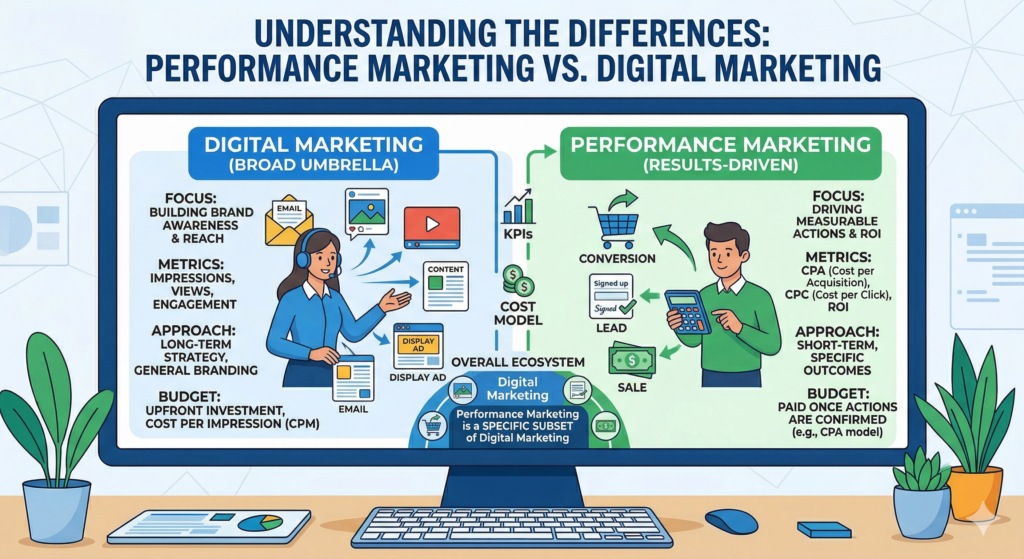
Performance Marketing vs Digital Marketing: Key Differences Explained | 2026 PERFORMANCE METRICS CPC CTR ROAS CPA LTV ROI: 340% Paid Campaign Q1 Conversion Rate: 8.4% Landing Page A/B Test 📱 Social 📧 Email ✍️ Content 🔍 SEO 💰 PPC Digital Marketing VS Performance Marketing Digital Marketing Performance Marketing vs Digital Marketing:What’s the Real Difference? // April 2026 // 15 min read // Strategy Guide One is a specific tactical discipline measured to the decimal. The other is a broad strategic universe. Understanding the difference between performance marketing and digital marketing is not just academic — it determines how you allocate your budget, build your team, and measure success. If you have ever sat in a marketing meeting and heard both terms used almost interchangeably, you are not alone. Many professionals — and even some marketers — blur the line between these two concepts. This comprehensive guide will give you a crystal-clear understanding of both, how they relate to each other, and how strong website design and website development power both strategies in 2026. $860B Global digital marketing spend in 2026 40% Of that budget allocated to performance channels 3.2× Average ROAS for optimized performance campaigns Defining Digital Marketing: The Broad Universe Digital marketing is the umbrella term for all marketing activities that use digital channels, technologies, and platforms to promote a brand, product, or service. It encompasses every online marketing discipline — from search engine optimization and content marketing, to email marketing, social media marketing, influencer collaborations, pay-per-click advertising, affiliate marketing, video marketing, and more. Think of digital marketing as the entire ecosystem of tools available to a modern marketer. It includes both brand-building activities (creating awareness and emotional connection) and direct-response activities (driving immediate action). Website design and website development are foundational to digital marketing — your website is the central hub where every digital channel ultimately leads. Key Disciplines Within Digital Marketing Search Engine Optimization (SEO) — organic search visibility through content and technical optimization Pay-Per-Click Advertising (PPC) — paid search and display ads on Google, Bing, and beyond Social Media Marketing — organic and paid presence on Instagram, TikTok, LinkedIn, etc. Content Marketing — blogs, videos, podcasts, infographics, and other value-driven content Email Marketing — automated and broadcast campaigns to nurture and convert subscribers Influencer Marketing — partnerships with creators to reach engaged audiences Affiliate Marketing — commission-based partnerships with publishers and promoters Website Design and Development — the foundation that all other digital channels rely upon DIGITAL MARKETING ECOSYSTEM Your Website 🔍 SEO 💰 PPC 📱 Social 📧 Email ✍️ Content ⭐ Influencer 🤝 Affiliate // fig.01 — digital marketing is an ecosystem; your website sits at its center Defining Performance Marketing: The Precision Discipline Performance marketing is a subset of digital marketing that is characterized by one defining feature: you only pay for measurable, specific outcomes. These outcomes might be clicks, leads, sales, installs, sign-ups, or any other defined conversion event. Unlike traditional brand advertising where you pay for impressions regardless of results, performance marketing is entirely outcome-based. Performance marketing channels include pay-per-click (PPC) advertising on Google and Bing, social media advertising on Meta, TikTok, and LinkedIn, affiliate marketing programs, influencer partnerships with tracked attribution, programmatic display advertising, and retargeting campaigns. What unites all of these is the ability to track every dollar spent against a specific, measurable result. The success of every performance marketing campaign is heavily dependent on where the traffic is sent — namely, your website. Poor website design can cause even the best-optimized ad campaigns to fail, because users arrive on a poorly designed page and leave before converting. This is why website development and performance marketing must be planned and optimized together. Side-by-Side: The Key Differences Performance Marketing Outcome-Driven Precision Pay only for measurable results ROI is tracked in real-time Short to medium time horizon Focused on bottom-funnel actions Requires strong landing pages PPC, affiliate, paid social, retargeting A/B testing and CRO are central Budget can be scaled instantly vs Digital Marketing Ecosystem-Wide Strategy Covers paid and organic channels Includes brand-building activities Long-term compounding results Spans the full marketing funnel Requires a complete web presence SEO, content, email, social, PPC Strategy, creative, and data combined Builds sustainable audience and brand “Performance marketing is the arrow. Digital marketing is the entire bow, quiver, and the archer’s training. You need both to hit the target consistently.” The Detailed Comparison Table Factor Performance Marketing Digital Marketing Payment Model Pay-per-result (CPC, CPA, CPL) Varies — fixed, retainer, or performance Primary Goal Immediate, measurable conversions Brand awareness + conversions Funnel Position Primarily bottom-of-funnel Full funnel (awareness to retention) Time to Results Fast — hours to days Slow to medium — weeks to months Risk Profile Lower financial risk (pay for results) Higher upfront investment required Key Channels Google Ads, Meta Ads, Affiliate, Retargeting SEO, Content, Email, Social, PPC, Video Measurement ROAS, CPA, CTR, LTV, conversion rate Traffic, engagement, reach, leads, revenue Website Role Landing pages are make-or-break Full website is central to all activity Brand Building Secondary / indirect Core objective alongside revenue Scalability Highly scalable with budget increases Scalable but organic channels take time WHERE EACH TYPE OPERATES IN THE FUNNEL AWARENESS Digital Marketing: SEO, Content, Social, Brand CONSIDERATION Both: Email, Retargeting, Reviews CONVERSION Performance Marketing: PPC, Affiliate, Paid Social Digital Marketing territory Performance Marketing focus // fig.02 — performance marketing dominates the bottom funnel; digital marketing spans all stages How Website Design Bridges Both Strategies Whether you are running a pure performance marketing campaign or executing a broad digital marketing strategy, the effectiveness of both ultimately comes down to your website. Specifically, your website design and website development quality determines whether the traffic you generate — whether paid or organic — converts into real business results. For Performance Marketing: Landing Pages Are Everything In performance marketing, every click costs money. A poorly designed landing page — one that loads slowly, has a confusing layout, or fails to clearly communicate value — wastes your ad spend. The best performance marketers obsessively optimize their

Uncategorized

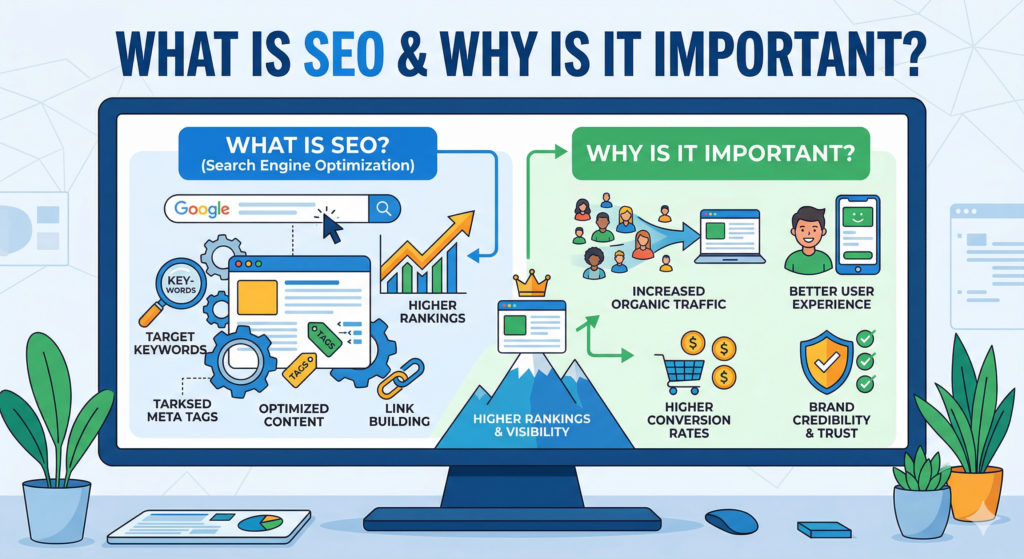
What is SEO and why is it important

What is SEO and Why is it Important? | Complete Guide 2026 🔍 best website design services near me → AD · SPONSORED #1 Best Website Design Company | Award Winning Agency www.yourwebsite.com › services › website-design Professional Website Development Services – Trusted competitor.com › website-development We build fast, modern websites that convert visitors into customers… Web Design & Development Agency | 10+ Years Experience another-site.com › web-design Content Backlinks Technical UX/Design Speed SEO ⚙ SEO FUNDAMENTALS What is SEO and Why is itImportant in 2026? 📅 April 2026 ⏱ 16 min read 🏷 Beginner to Advanced SEO — Search Engine Optimization — is the practice of improving your website so that it appears higher in search engine results pages (SERPs) when people search for terms related to your products or services. Done right, SEO is the most powerful, cost-effective, and sustainable form of digital marketing available in 2026. 68% Of online experiences begin with a search engine 53% Of all website traffic comes from organic search 0.63% Of searchers click on page 2 results 14.6% Close rate from SEO leads vs 1.7% from outbound 01 How Search Engines Actually Work Before you can optimize for search engines, you need to understand what they do. Google and other search engines like Bing, DuckDuckGo, and Yahoo operate through three fundamental processes: crawling, indexing, and ranking. Crawling Search engine bots (also called “spiders” or “crawlers”) continuously browse the web by following links from page to page. They discover new content and re-crawl existing content to detect updates. The structure of your website development — how pages are linked internally, whether your sitemap is properly configured, whether your robots.txt is correctly set up — directly affects how thoroughly your site is crawled. Indexing Once a page is crawled, its content is processed and stored in the search engine’s massive index — essentially a database of all the web content the engine has discovered. Pages that are not indexed cannot rank, regardless of how well-optimized they are. Proper website development practices, such as avoiding duplicate content and ensuring canonical tags are correctly implemented, keep your pages indexed cleanly. Ranking When a user performs a search, the engine evaluates hundreds of ranking factors to determine which pages from its index are most relevant and trustworthy for that specific query. This is where SEO strategy directly comes into play. Google uses over 200 confirmed ranking factors, though the most important ones are consistently centered on three pillars: content quality, authority (backlinks), and technical health. HOW SEARCH ENGINES WORK 🕷 CRAWL Bots discover your pages 🗂 INDEX Content is stored & categorized 🏆 RANK 200+ factors determine position 👤 User searches Your website design and development quality directly affects all three stages // fig.01 — the three-stage search engine pipeline every website owner must understand 02 The Three Pillars of Modern SEO In 2026, SEO can be broadly categorized into three interconnected disciplines. Each is essential — neglect any one of them and your overall SEO performance will suffer, regardless of how strong the others are. 📄 On-Page SEO Optimizing the content and HTML elements on each page — titles, meta descriptions, headings, keywords, internal links, and content quality. 🔗 Off-Page SEO Building authority through backlinks from reputable websites, brand mentions, social signals, and digital PR strategies. ⚙️ Technical SEO Ensuring search engines can efficiently crawl, index, and understand your website — site speed, mobile optimization, schema markup, Core Web Vitals. 03 Why SEO is Critical for Your Business in 2026 The question is not whether your business needs SEO — it absolutely does. The question is how aggressively you prioritize it. Here is why SEO is arguably the highest-ROI digital marketing investment a business can make in 2026: 1. SEO Drives Compounding, Free Traffic Unlike paid advertising, where traffic stops the moment your budget runs out, SEO builds a compounding asset. A well-optimized blog post or service page can drive qualified traffic for years with minimal ongoing maintenance. This makes SEO’s cost-per-acquisition dramatically lower than virtually any paid channel over a 12–24 month timeframe. 2. People Trust Organic Results More Than Ads Studies consistently show that organic search results receive significantly higher click-through rates than paid ads for most query types. Appearing organically signals to users that your business is a credible, established authority — not just an advertiser buying visibility. This trust translates directly into higher conversion rates from organic traffic. “SEO is not about gaming the system. It is about building the most genuinely useful, trustworthy, and technically excellent website possible — and then letting search engines reward you for it.” 3. SEO Captures High-Intent Buyers When someone types “website design company in Delhi” into Google, they are actively looking to buy. Search intent is far more valuable than passive social media reach. SEO puts your brand directly in front of people who are already in buying mode — a targeting precision that is very difficult to replicate with other channels. 4. SEO Data Informs Every Other Marketing Decision The keyword research process reveals exactly what your audience is searching for, in their own words. This intelligence improves your social media content, your paid ad copy, your email subject lines, and your product positioning. SEO is not siloed — it makes every other marketing effort smarter and more effective. SEO vs PAID ADS: TRAFFIC VALUE OVER TIME High Mid Low M1 M3 M6 M9 M12 M18 M24 SEO Traffic (Grows) Paid Ads (Stops When Budget Ends) Budget cut // fig.02 — organic SEO traffic compounds over time; paid traffic vanishes when the budget stops 04 On-Page SEO: Optimizing What You Control On-page SEO refers to every optimization you can make directly on your web pages. It is where website design and website development intersect most directly with search performance. Here are the most impactful on-page elements: Title Tags and Meta Descriptions Your page’s title tag is one of the most important on-page ranking signals. It tells both users and search engines what the

Uncategorized

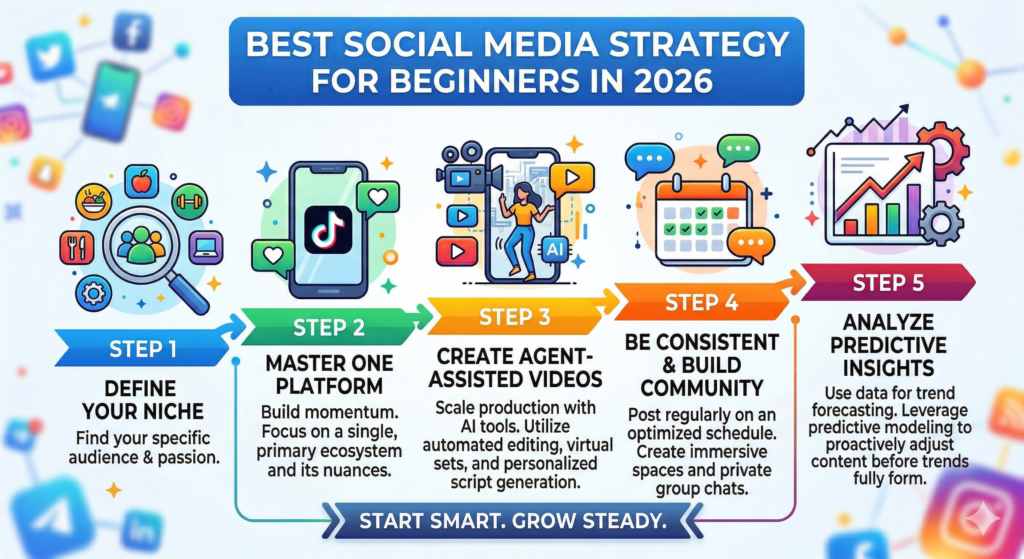
What is the best social media strategy for beginners in 2026

Best Social Media Strategy for Beginners in 2026 | Digital Growth Guide ♪ in ♥ 24.5K ↗ 87% Social Media · 2026 Guide The Best Social Media Strategy for Beginners in 2026 📅 April 2026 ⏱ 14 min read 🏷 Beginner Friendly In 2026, social media is no longer optional — it is the storefront, the handshake, and the megaphone of your brand. Whether you are a solo creator, a small business owner, or a startup, building a smart social media strategy from day one can be the difference between obscurity and explosive growth. If you are just starting out, the sheer number of platforms, content types, algorithms, and trends can feel paralyzing. This comprehensive guide will walk you through every step of building a winning social media strategy in 2026 — from choosing the right platforms to creating content that converts, and how strong website design and website development amplify your social presence. 5.8B Active social media users worldwide in 2026 3.2h Average daily time spent on social platforms 91% Brands using social media for marketing Why Social Media Strategy Matters More Than Ever in 2026 The social media landscape has shifted dramatically. Algorithms now favor consistency and authenticity over frequency. Audiences demand real value — entertainment, education, or inspiration — before they follow, like, or buy. In 2026, a thoughtful strategy beats a desperate posting spree every single time. Moreover, social media now works in tight integration with your website design and website development. Every social post can and should drive traffic to a well-optimized, beautifully designed website where conversions happen. Without this link, you are building on rented land with no asset to show for it. 💡 Pro Insight Social media gets the attention; your website captures the lead. Investing in both simultaneously is the 2026 growth formula every beginner must understand. PLATFORM POPULARITY IN 2026 2.1B Instagram 2.4B TikTok 2.8B YouTube 3.2B Facebook 1.1B LinkedIn 0.5B Pinterest Fig 1. Monthly active users across major social platforms in 2026 (approximate) Step 1 — Define Your Goals Before You Post Anything The most common beginner mistake is starting with content before defining purpose. Before you open any app, answer these questions: What do you want social media to do for your business? Are you building brand awareness, generating leads, driving traffic to your website, or growing a community? Your goals will determine everything — which platforms you use, what content you create, and how you measure success. Use the SMART framework: goals must be Specific, Measurable, Achievable, Relevant, and Time-bound. Common Social Media Goals for Beginners Drive 500 monthly visitors to your website through social referrals Grow your Instagram following to 1,000 engaged followers in 90 days Generate 10 qualified leads per month through LinkedIn content Build brand awareness by reaching 50,000 unique impressions monthly Increase sales conversions by linking social posts to optimized landing pages Step 2 — Know Your Audience Inside Out You cannot speak to everyone. In 2026, the brands winning on social media are those with a laser-focused understanding of one specific audience. Create a detailed audience persona that includes demographics (age, location, occupation), psychographics (values, interests, pain points), online behavior (which platforms they use, when they’re active, what content they engage with), and buying triggers. 🎯 Action Step Spend at least one week researching before creating content. Scroll through your competitors’ comment sections. Read Reddit threads. Join Facebook groups in your niche. This research will save you months of guessing. Step 3 — Choose the Right Platforms (Not All of Them) Beginners often try to be everywhere at once and end up being mediocre everywhere. The smarter approach in 2026 is to master one or two platforms before expanding. Here is a breakdown of where to focus based on your niche: Platform Best For Content Type Audience Age Instagram Visual brands, e-commerce, lifestyle Reels, carousels, stories 18–35 TikTok Entertainment, education, Gen Z Short videos, trends 16–30 LinkedIn B2B, professional services, SaaS Articles, thought leadership 25–45 YouTube Long-form education, tutorials Videos, Shorts 18–45 Pinterest DIY, food, fashion, home decor Pins, boards 25–50 Facebook Local business, communities, events Posts, groups, ads 30–55 CONTENT CALENDAR — WEEK VIEW MON TUE WED THU FRI SAT SUN 📸 Instagram Carousel Post 🎵 TikTok Trend Video 💼 LinkedIn Article / Post ▶ YouTube Short / Reel 📸 Instagram Reel / Story 📌 Pinterest Pin Board 📊 Analytics Review Day Track → Adjust → Plan Next Week Consistency is the algorithm’s love language — post on a schedule and stick to it Fig 2. A beginner-friendly weekly content calendar template for 2026 Step 4 — Build a Content Pillars System Instead of waking up every morning wondering what to post, successful social media beginners in 2026 operate on content pillars — 3 to 5 core themes that align with your brand and audience. Every piece of content maps to one of these pillars, ensuring variety while maintaining brand consistency. 01 Educate Share tips, how-tos, and industry insights. Educational content builds trust and positions you as an expert. For example, a website development agency might post “5 website speed mistakes killing your conversions.” 02 Entertain Humor, storytelling, behind-the-scenes, and relatable content that makes people feel something. Entertainment is what makes content shareable and algorithm-friendly. 03 Inspire Success stories, client transformations, powerful quotes, and motivational narratives. Inspirational content drives saves and shares — the highest-value engagement signals in 2026. 04 Promote Direct offers, product showcases, service announcements, and call-to-actions. Keep this pillar to no more than 20% of your content — sell too much and you will lose your audience. 05 Engage Questions, polls, user-generated content, and community spotlights. Engagement content builds the two-way relationship that transforms followers into loyal fans and buyers. Step 5 — The Website Connection: Why Your Social Strategy Needs a Home Base Here is a truth many beginners miss: social media platforms are rented real estate. Algorithms change. Accounts get banned. Platforms lose popularity. Your website is the one digital asset you fully own and control.

Uncategorized

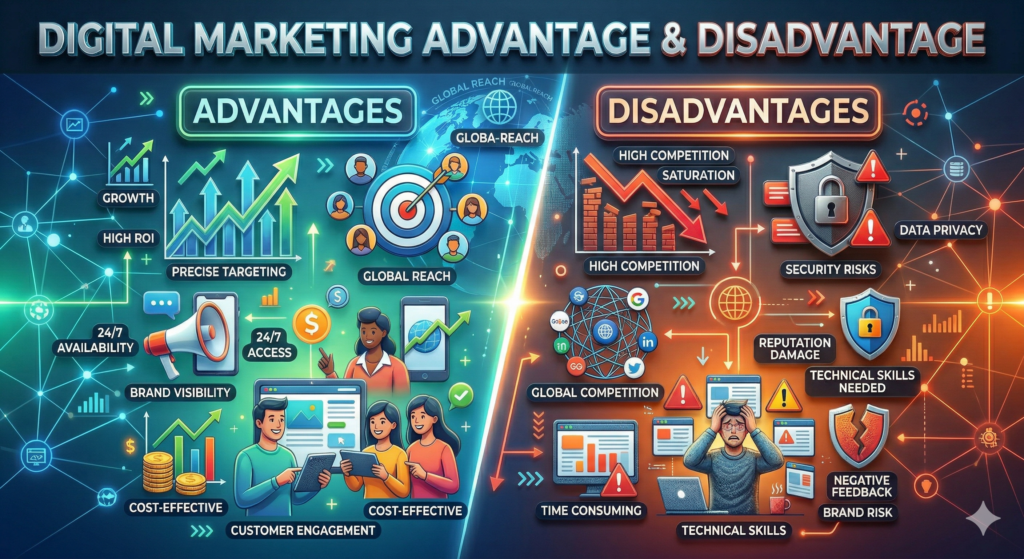
What Is Digital Marketing Advantage & Disadvantage

What is Digital Marketing? Advantages & Disadvantages Digital Marketing What is Digital Marketing? A Complete Guide to Its Advantages & Disadvantages April 13, 2026 18 min read Marketing Essentials In an era where over 5.4 billion people use the internet every day, digital marketing has evolved from a buzzword into the beating heart of every thriving business. But what exactly is it — and is it the right move for you? Digital marketing is the umbrella term for all marketing activities that use digital channels, platforms, and technologies to connect with current and potential customers. Unlike traditional marketing — which relies on billboards, television commercials, and print media — digital marketing operates in the online world, leveraging search engines, social media platforms, email, mobile apps, websites, and content to deliver targeted messages to specific audiences at precisely the right moment. From a local bakery promoting its fresh pastries on Instagram to a multinational corporation running automated email sequences reaching millions of subscribers worldwide, digital marketing is infinitely scalable, deeply measurable, and remarkably accessible. It has fundamentally changed the relationship between businesses and their customers — making marketing a two-way conversation rather than a one-sided broadcast. $786BGlobal Digital Ad Spend by 2026 5.4BInternet Users Worldwide 63%Of purchases influenced by online search The Core Pillars of Digital Marketing Before diving into the advantages and disadvantages, it’s essential to understand what digital marketing actually encompasses. It is not a single activity — it is a rich ecosystem of disciplines that work together to attract, engage, and convert audiences. 1. Search Engine Optimization (SEO) SEO is the art and science of improving a website’s visibility in organic (non-paid) search engine results pages. When a user types a query into Google, Bing, or any other search engine, SEO determines which websites appear at the top. This involves keyword research, technical website optimization, high-quality content creation, and building authoritative backlinks from other reputable sites. 2. Pay-Per-Click Advertising (PPC) PPC allows businesses to place ads in front of highly targeted audiences and pay only when a user actually clicks on the advertisement. Google Ads, Meta Ads, LinkedIn Ads, and Microsoft Advertising are the dominant platforms. With PPC, you can launch a campaign today and start generating traffic within hours — making it one of the fastest routes to market visibility. 3. Social Media Marketing Social media marketing involves creating, publishing, and promoting content across platforms like Instagram, Facebook, TikTok, LinkedIn, X (formerly Twitter), Pinterest, and YouTube. It encompasses both organic content — posts, stories, reels, and videos — and paid social advertising. Social media is where brand personality lives, communities form, and viral growth happens. Digital marketing spans every screen, platform, and device your audience uses daily. 4. Content Marketing Content marketing is the strategic creation and distribution of valuable, relevant, and consistent content to attract and retain a clearly defined audience — and ultimately drive profitable customer action. Blog posts, podcasts, video series, infographics, eBooks, webinars, and case studies all fall under this category. Great content marketing educates and entertains while subtly guiding customers along their buying journey. 5. Email Marketing Despite being one of the oldest digital marketing channels, email marketing consistently delivers the highest return on investment across the entire marketing landscape. With a global user base of over 4.3 billion email users, a well-crafted email campaign can nurture leads, recover abandoned carts, onboard new customers, and drive repeat purchases — all on autopilot. 6. Influencer & Affiliate Marketing Influencer marketing harnesses the trust and reach of social media personalities to promote products and services to their engaged audiences. Affiliate marketing, meanwhile, is a performance-based model where partners earn a commission for every sale or lead they generate. Both models turn third-party voices into powerful marketing assets. ✦ The Powerful Advantages of Digital Marketing Digital marketing has democratized the playing field in ways that were unimaginable just two decades ago. Here is a comprehensive look at why millions of businesses have shifted their marketing budgets online. 🎯 Laser-Precise Targeting Digital platforms allow you to target audiences by age, gender, location, income, interests, online behavior, purchase history, and even life events. A retirement planning firm can target only users aged 45–65 who have shown interest in financial planning. This granularity is impossible in traditional media. 💰 Cost-Effective for All Budgets You can launch a Facebook ad campaign with as little as $5 per day. A well-optimized blog post can generate organic traffic for years without ongoing spend. Digital marketing offers extraordinary ROI — especially for small and medium businesses that cannot afford TV spots or magazine spreads. 📊 Real-Time Measurability Every click, impression, conversion, open rate, bounce rate, and cost-per-acquisition is tracked and reported in real time. This allows marketers to make data-driven decisions, kill underperforming campaigns instantly, and double down on what works — eliminating guesswork entirely. 🌍 Global Reach, Local Precision A single digital campaign can reach audiences in over 190 countries simultaneously. Yet that same campaign can be hyper-localized to show different messages to users in different cities, neighborhoods, or even within a specific radius of a physical store location. 🔁 Two-Way Customer Interaction Social media, live chat, comment sections, and email replies transform marketing from a monologue into a dialogue. Brands that engage meaningfully with their audience build trust, loyalty, and community — turning customers into brand advocates who amplify your message for free. ⚡ Speed and Agility A digital campaign can go live within minutes of creation. If market conditions change, a competitor launches a new product, or a trend emerges, you can update your ads, emails, and content in real time — something absolutely impossible with a billboard or a TV spot already in production. 🤖 Automation at Scale Marketing automation tools allow businesses to send the right message to the right person at the right time — automatically. Welcome sequences, abandoned cart reminders, birthday offers, and re-engagement campaigns can all run 24/7 without human intervention, multiplying your marketing output without multiplying your costs. 📈 Scalability Without Ceiling

Scroll to Top